The interest rate on a loan offer is the number lenders like to put in bold on the homepage. APR is the number that actually tells you what the loan costs. They’re not the same thing, and the gap between them is exactly where a seemingly attractive offer can turn out to be more expensive than a competitor advertising a slightly higher headline rate.
What Interest Rate Actually Measures
The interest rate is the cost of borrowing the principal itself, expressed as a percentage. If the interest rate on a loan is 10% and you owe $10,000 then the 10% is applied to your remaining debt. It is a real, substantive number, but a somewhat short one because it does not incorporate most of the other costs that are associated with actually getting the loan.
What APR Adds to the Picture
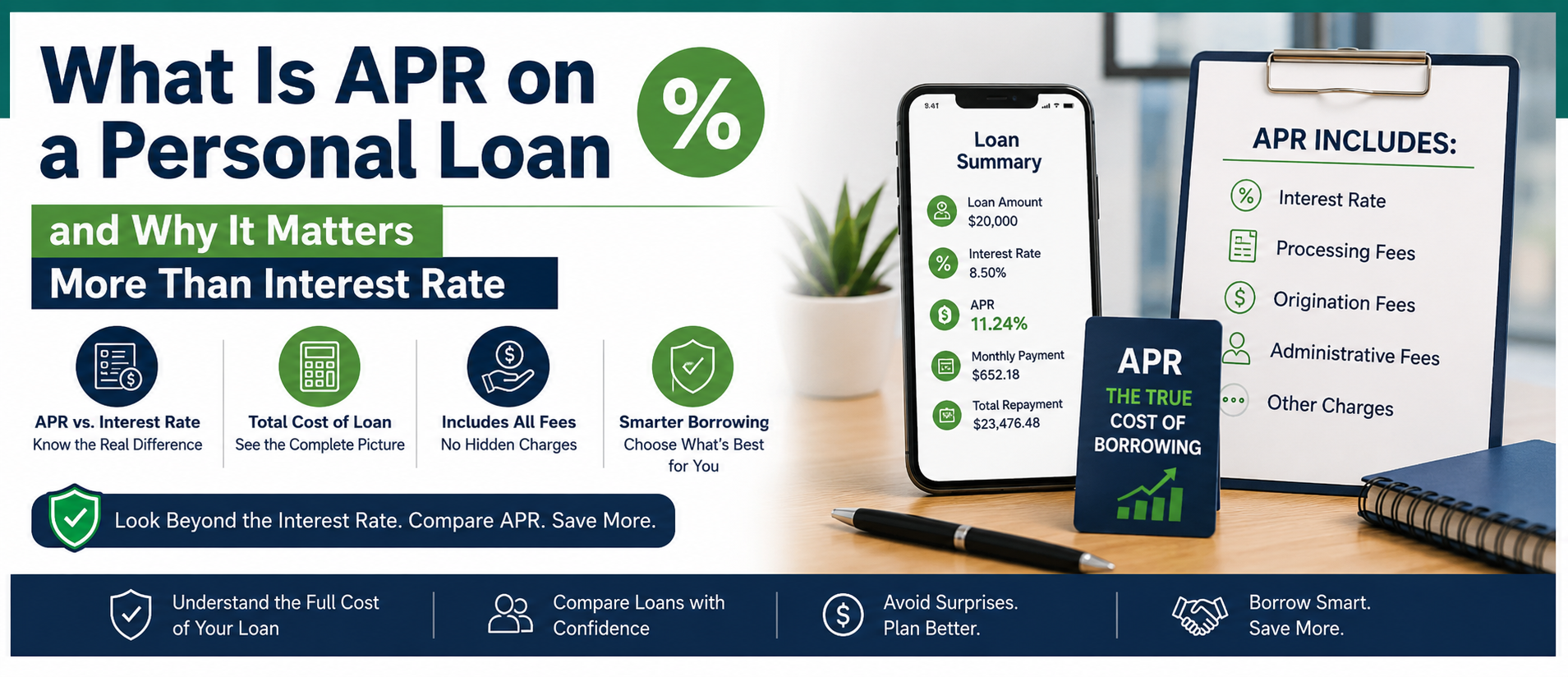
Annual Percentage Rate rolls the interest rate together with mandatory upfront fees, most commonly an origination fee, spread out over a year, to give you a single number reflecting the full cost of borrowing. Personal loan origination fees are typically 1% to 12% of your loan amount, deducted from your loan proceeds before you receive them, and as origination fees are included in APR, it is almost always higher than the simple interest rate on the same loan.
For example, a five-year, $10,000 personal loan with a 15.63% interest rate and an 8.99% origination fee comes in at a total APR of 20.02%, which is more than four percentage points higher than the interest rate a lender might advertise. On that loan you would be able to take home $9,101 after the origination fee is applied, yet you will still have to pay the loan based on the full $10,000; that’s not something an interest rate can tell you.
Why Comparing Interest Rates Alone Can Backfire
Suppose there are 2 loan offers that offer $10,000. Lender A charges a 5% origination fee with an 11% interest rate. B lender offers a 0% origination fee on a 13% rate. If the only factor to compare is the interest rate, then Lender A appears to be the cheaper option. The APR of Lender B might be lower after fees are included, since Lender A’s fee represents actual cost not included in the headline rate. That’s exactly what APR is there for – it’s why federal law mandates lenders provide APR in clear, conspicuous terms on all loan offers, aside from the interest rate.
What’s in 2026 Average Rates, and What That Tells You
According to Fed, Bankrate, and NerdWallet data, the average interest rate on personal loans with good to excellent credit is approximately 11% to 15% for shorter terms, and the range of interest rates offered in the market runs much higher. They starts from about 6% for borrowers with the best credit scores to 36% for borrowers with weaker credit. Also, all federal credit unions have a maximum interest rate of 18% no matter what type of credit score you have, so if the headline rate seems to match up with an online lender’s quote, you should compare it directly because the actual fee structure and rates can vary in significant ways.
The lesson here is the wide range itself: It’s not just a matter of whether you’re looking at the interest rate or the APR (that can vary from single digits up to well over 30% depending on your credit profile) — the difference between the two can mean thousands of dollars over the course of a loan.
What APR Doesn’t Include
Knowing APR limits is also important because they are not an accurate representation of all costs. Late fees, prepayment penalties and non-sufficient funds (NSF) fees are also not usually factored into the APR calculation, but could be charges you may eventually face based on how this loan rolls out.
APR is the actual cost of the loan if you use it as you’d expect, but it doesn’t account for all the fees that could apply, so you should still read a loan’s terms and conditions for these fees, especially prepayment penalties if you believe you’ll pay off the loan early.
How to Actually Use APR When Comparing Loans
A few practical habits make APR genuinely useful rather than just another number to skim past. Always compare APR to APR, never APR on one offer against the plain interest rate on another, since that comparison is comparing two fundamentally different things dressed up to look similar. Check whether an origination fee is deducted from your loan proceeds or added to your balance, since either way it affects your real cost even though the mechanics differ slightly.
And factor in loan term alongside APR, since a lower APR over a much longer term can still cost more in total interest paid than a slightly higher APR over a shorter one, depending on the specific numbers involved.
Comparing Real Offers
Understanding the difference between interest rate and APR is most useful when you actually put it into practice, comparing real offers side by side rather than picking whichever one leads with the lowest-sounding number. If you want to compare personal loan options and see the full APR, not just the interest rate, across lenders serving a range of credit profiles, theloans.pro provides educational resources on loan terms alongside tools to compare offers before you commit to anything.
FAQs
What’s the actual difference between interest rate and APR?
Interest rate is simply the rate that is charged on the principal loan amount, but an APR incorporates any fees required to obtain the loan, such as an origination fee, and annualizes it so that it is a single rate that reflects the total loan cost.
Why is APR usually higher than the interest rate on the same loan?
Because APR includes fees the plain interest rate doesn’t, most commonly an origination fee. APR is almost always equal to or higher than the interest rate, and a bigger gap between the two numbers usually signals a larger fee attached to that specific offer.
What is a typical personal loan APR in 2026?
Rates vary widely by credit profile. Average APRs for loans with good to excellent credit are estimated to be between 11% and 15% depending on the credit profile, with an average range across the market of 6% to 36% for borrowers with the weakest credit to the strongest.
Does APR include every fee a loan could charge?
No. While APR will include costs required upfront, such as origination fees, it will likely not include late fees, non-sufficient funds fees, or prepayment costs, so you should still take a close look at a loan’s terms and conditions before including these fees.

 Content List:
 Applying does NOT affect your FICO® Score!