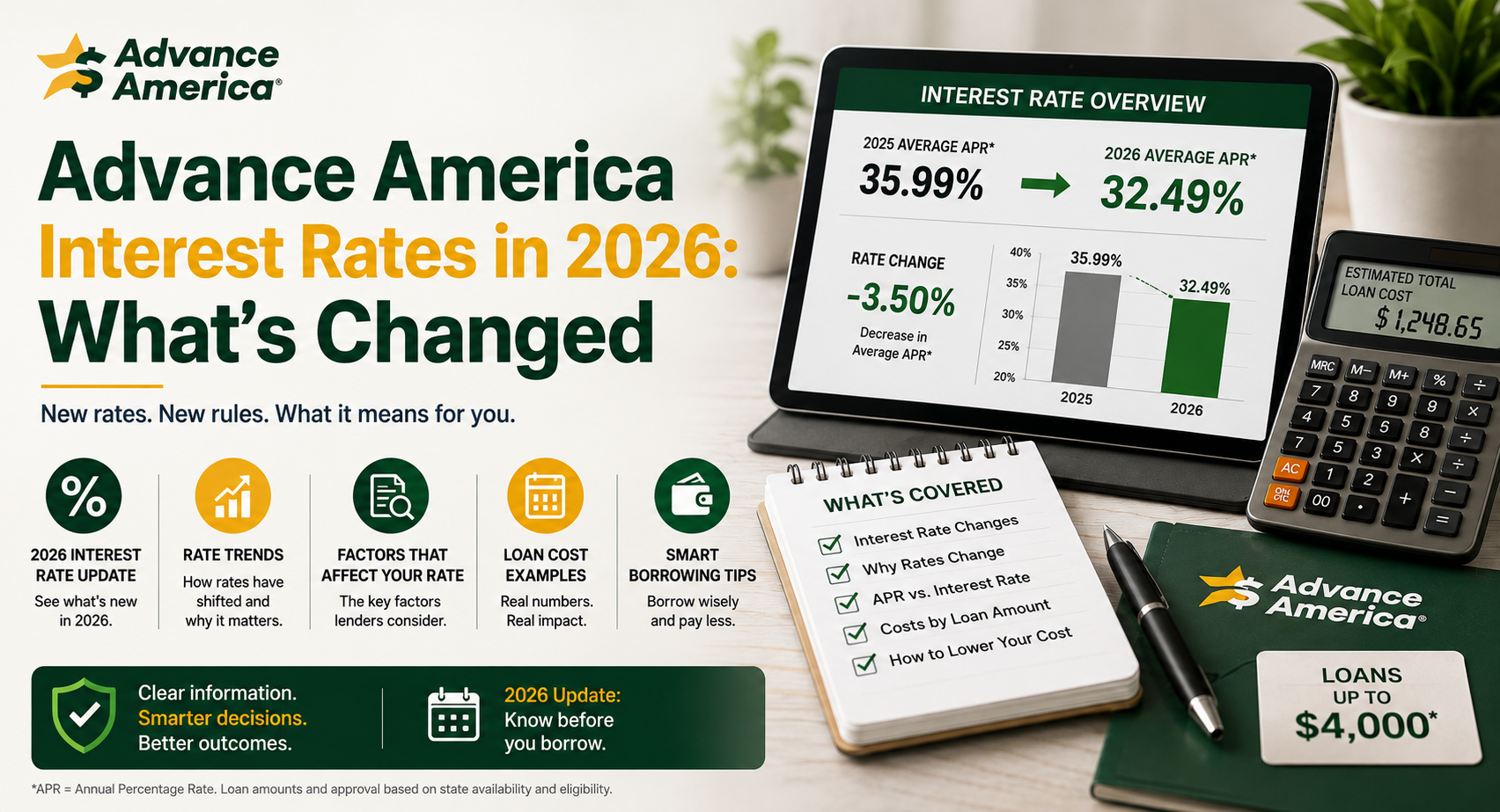
If you’re checking whether Advance America Interest Rates have gotten better, worse, or stayed the same heading into 2026, the honest answer is a mix. The fundamentals of its pricing scheme haven’t really changed, but its regulatory framework sure has.
The Baseline Hasn’t Moved Much
Advance America’s core pricing remains largely consistent with prior years. The typical cost of Cash Advance loans is still the same old flat rate of about $15 per $100 borrowed, which translates to an estimated APR of 391% – 400% based on a loan period of two weeks – close to the average payday loan APR in the United States in 2026. The APRs for installment loans are usually anywhere between 143% – 690%. If you were expecting a major rate cut or a new lower-cost product from Advance America specifically, that hasn’t materialized. What has changed sits mostly at the regulatory level, not in Advance America’s own pricing decisions.
More States Are Capping Rates, Shrinking Where High-Rate Loans Are Even Legal
The bigger story for 2026 is not that of Advance America’s rates but rather the number of states where it is impossible for companies to charge even remotely close to the rates charged outside the state. Currently, around 20 states along with Washington D.C. have laws that limit payday loan rates at around 36% per annum including the fees, and thus make it impossible for high interest rate products like those of Advance America’s Cash Advance.
One of the most recent examples of the same is the 36% interest cap implemented by Minnesota’s Governor Tim Walz. This state was charging around 220% per annum before this law was passed. Rhode Island has gone further still, passing a 36% APR cap on payday lenders set to take effect January 1, 2027, meaning it’s already reshaping how lenders like Advance America plan their footprint in that state well before the law technically kicks in.
The practical effect: Advance America’s triple-digit rate products are increasingly a feature of a shrinking map, available in the states that still permit them, effectively unavailable in a growing list that doesn’t. If you’re in a 36%-cap state, you likely won’t find Advance America’s traditional payday product there at all, or you’ll see a meaningfully different, lower-rate structure if the company offers anything in that state.
The Federal Withdrawal Protection Rule Is in a Strange Limbo
This is the part most borrowers don’t know about, and it’s genuinely changed in 2026. The CFPB’s payday lending rule, which limits lenders to two consecutive failed withdrawal attempts from a borrower’s bank account before requiring fresh authorization, formally took effect back on March 30, 2025, after nearly a decade of litigation. On paper, that protection still applies today.
In reality, the picture is murkier. Right before the rule went into effect, the CFPB signaled that it would not make the enforcement of such payment requirements a priority, instead moving on to oversee other areas. Finally, in its 2026 Regulatory Agenda published in July, the CFPB announced that it would reexamine and possibly rescind these provisions, which, according to the Bureau itself, is an act of deregulation. In other words: the rule still exists, but is being reviewed by the federal government for rescinding, and enforcement is no longer a priority.
State attorneys general can still enforce it directly even without federal prioritization, but the level of protection a borrower can actually count on from this rule is less certain heading into 2026 than the plain text of the regulation suggests.
What This Means If You’re Considering a Loan
A few practical takeaways follow from all this. First, don’t assume the federal two-attempt withdrawal protection will necessarily be enforced against a lender that violates it, given the current federal enforcement posture, even though it remains the law as written. Second, your state matters more than ever. Check your state’s specific rate cap before assuming Advance America’s national rate ranges apply to you, since a growing number of states simply don’t permit those rates anymore. Third, the underlying math hasn’t changed: a $15-per-$100 flat fee is still roughly a 391% APR, and that’s still one of the most expensive ways to borrow money available, regardless of what’s happening in Washington or your state legislature this year.
Cheaper Alternatives Are Still the Better First Stop
None of this regulatory movement changes the core advice that’s applied for years: a payday-style loan should be a last resort, not a routine option. Before considering Advance America or a similar lender, it’s worth checking a credit union Payday Alternative Loan, capped at 28% APR by federal rule, or a standard installment loan from a lender that evaluates your income and ability to repay rather than charging a flat fee regardless of your situation.
If you want to compare loan options and see current rates from lenders across the credit spectrum, theloans.pro provides educational resources on loan types and terms alongside tools to compare offers before you commit to anything.
FAQs
Has Advance America lowered its interest rates in 2026?
Not meaningfully at the national level. Core rates, at $15 per $100 for Cash Advances and 143% to 688% APR for installment loans, appear generally stable compared to previous years despite the reduction in availability in states with rate caps.
Is the federal rule limiting withdrawal attempts still in effect?
Technically yes, the rule became effective on March 30, 2025; however, the CFPB has deprioritized the enforcement of this rule, as evidenced by its Regulatory Agenda for 2026, which indicates an intention to reexamine the rule.
Which states have banned or capped Advance America-style payday rates?
At least 20 states and D.C. have payday loan limits of roughly 36% APR, with some recent additions being Minnesota, while Rhode Island’s 36% limit will be in effect starting January 1, 2027.
Is there a cheaper alternative to an Advance America loan?
Yes. Payday Alternative Loans by credit unions have an APR cap of 28%, and many internet lenders provide loans to people with poor credit ratings at interest rates that are significantly lower than payday loans.

 Content List:
 Applying does NOT affect your FICO® Score!