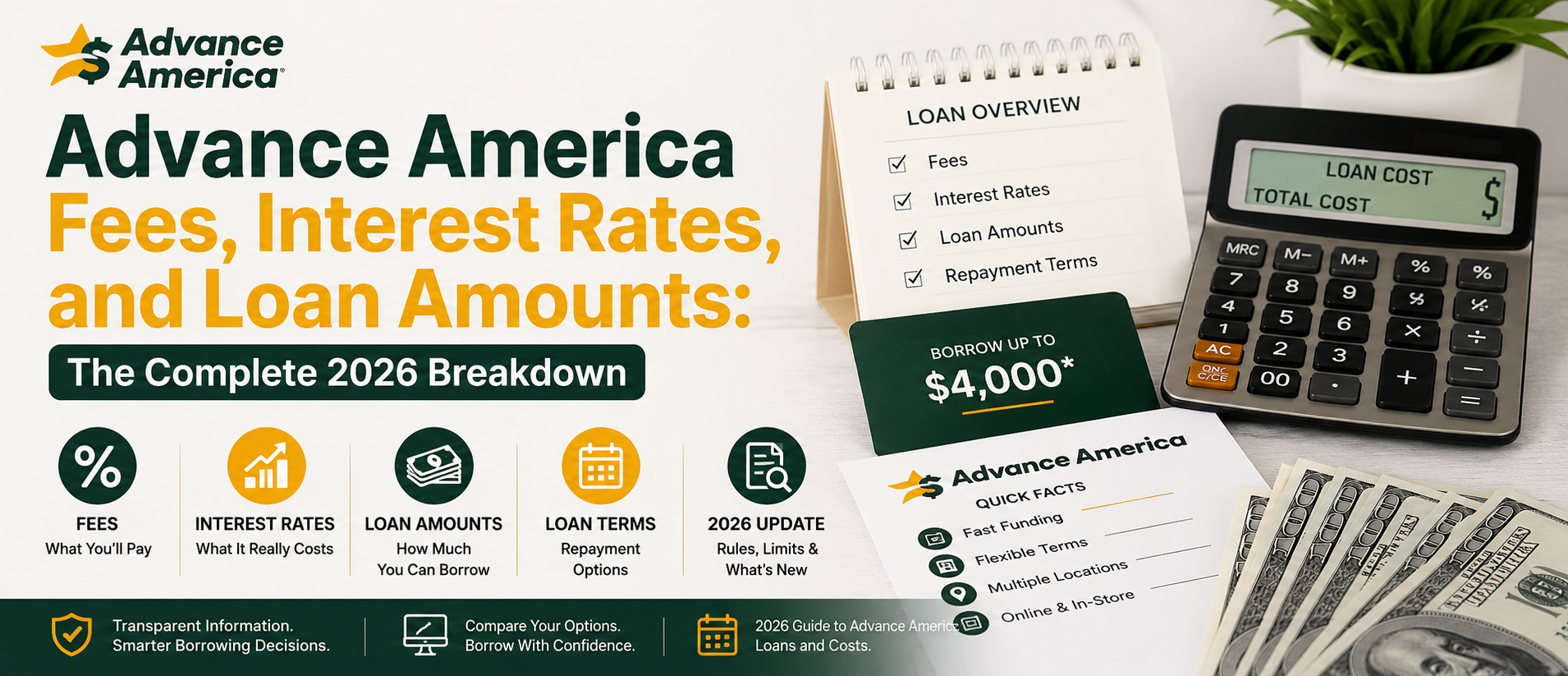
Advance America is one of the country’s biggest short-term lender organizations, boasting over 1,500 storefronts in approximately two dozen states and online. It was established in 1997 and is part of Grupo Elektra, providing payday loans, installment loans, title loans, lines of credit, and more. The true cost of borrowing, however, can be significantly different depending on the type of product, the state and the amount of borrowing. This is the complete breakdown of 2026.
Cash Advances (Payday Loans): Fees and APR
Advance America’s payday loan product is sold as a Cash Advance and has a fixed fee as opposed to a regular compound interest rate. The usual charge is $15 for every $100 borrowed, instead of compounding interest every day.
When you break the price down to an annualized figure, as federal law requires, that flat fee becomes more expensive. The Truth in Lending Act requires that the APR be computed as if the loan were renewed on a 2-to-4-week basis for a full year; the typical term is just 2 to 4 weeks, but the fee works out to an implied APR of approximately 400%, and as much as 460% in states such as California where local caps on fees and loan terms apply.
The minimum amount of the loans for Cash Advances begin at about $100, and the maximum amount of the payday loans are listed as $2,000 in states in which Advance America extends them, which is quite high when compared to the $1,500 limit that most other payday lenders have.
Installment Loans: Fees and APR
Advance America’s installment loan product spreads repayment over a longer term, typically several months, with fixed monthly payments instead of a single lump-sum due date. Rates here are lower than the payday product but still land solidly in triple-digit territory for most borrowers: APRs commonly range from around 143% up to nearly 690%, varying significantly by state and by the specific loan terms offered.
A real-world example of the cost makes this quite clear: A $650 installment loan in South Carolina for six months costs $1,341.12, or 348% APR. This loan product is typically offered for $100 and may exceed $5,000, depending on the state in which the borrower resides and meets other requirements, and Advance America does not impose a prepayment penalty if the borrower pays off the loan early.
Title Loans and Lines of Credit
Advance America also offers title loans, which use a vehicle as collateral, and in some states, an open-ended line of credit product. Both carry rates and terms that vary significantly by state regulation, and title loans in particular carry the added risk of vehicle repossession if payments aren’t kept current, a meaningfully different risk profile than an unsecured installment loan.
Additional Fees to Know About
Beyond the core interest or flat fee structure, a few other charges can apply. Advance America may charge an origination fee on installment loans, disclosed during the application process before you commit. Late payment fee policies aren’t consistently disclosed across all states and products, so it’s worth confirming this directly for your specific loan before signing. On the more borrower-friendly side, there’s no prepayment penalty on installment loans, and the company runs a rewards program that offers points for on-time payments, redeemable toward fee discounts on future loans.
One consumer protection worth knowing: under CFPB rules in effect since March 2025, Advance America is limited to two consecutive attempts to withdraw a payment from your bank account. If both attempts fail, they need your explicit permission before trying again, which limits how much a single missed payment can spiral into repeated overdraft fees on your end.
Why the Rates Vary So Much by State
Advance America’s pricing isn’t arbitrary. Payday and installment lending rates are set within the limits each state’s own regulations allow, and those limits differ dramatically. Some states cap fees tightly, pushing effective APRs toward the lower end of Advance America’s range, while others allow the higher triple-digit rates seen in states like South Carolina and California. This is why the company asks for your zip code before showing you actual loan terms; the offer you see is built around what’s legally permitted where you live, not a single nationwide rate card.
Should You Consider an Advance America Loan?
Because of the rates charged, most financial guidance considers such products to be just one alternative for a true emergency when a cheaper or quicker option is not available at all. It’s also a good idea to determine if a credit union Payday Alternative Loan (PAL), which is limited to 28% APR according to federal law, or a traditional bad-credit installment loan from another lender could meet the same need at a lower cost before applying for a loan.
If you want to compare installment loan options side by side, including lenders with lower rate structures than a traditional storefront payday lender, theloans.pro provides educational resources on loan types and terms alongside tools to compare offers before you commit to anything.
FAQs
What is the typical fee for an Advance America Cash Advance?
The standard fee is $15 per $100 borrowed, a flat charge rather than accruing daily interest, which annualizes to an implied APR of roughly 400% under federal disclosure rules.
What’s the maximum loan amount Advance America offers?
Cash Advances typically max out around $2,000, while installment loans can go up to $5,000 depending on your state and qualification, both starting as low as $100.
Does Advance America charge a prepayment penalty?
No. Installment loans can be paid off early with no additional penalty, which can meaningfully reduce total interest paid compared to running the loan for its full term.
Are Advance America’s rates the same in every state?
No. Rates and fees are set within each state’s specific lending regulations, which is why loan terms are shown only after you provide your zip code, and why APRs can range from roughly 143% to nearly 690% depending on where you live and which product you’re using.

 Content List:
 Applying does NOT affect your FICO® Score!